
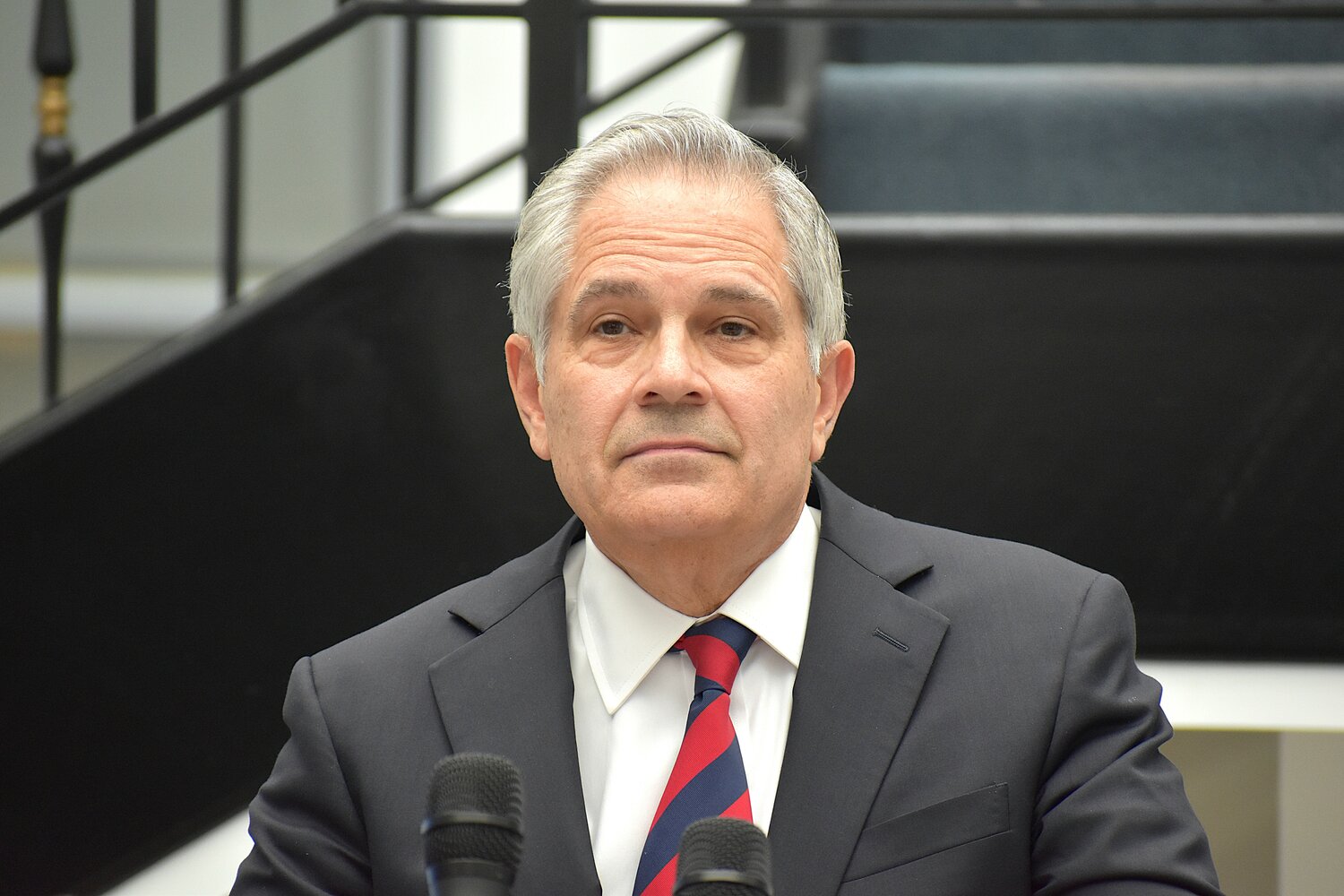


Pennsylvania’s attorney general now has the authority to step in whenever District Attorney Larry Krasner’s office seeks to undo a conviction, the state’s highest court ruled this week.
Since Krasner took office in 2018, city prosecutors have “repeatedly lacked candor to the court, misrepresented facts, failed to conduct adequate investigations, and inexplicably dodged necessary evidentiary hearings” when reviewing old verdicts, Pennsylvania Supreme Court Justice Kevin Dougherty wrote in a 109-page majority opinion.
The ruling is potentially a major blow to Krasner, a progressive prosecutor who has often touted his team’s exonerations and work to correct the alleged wrongs of his predecessors — who he has argued were so eager to lock people up and deliver harsh sentences that they sometimes concealed the truth.
Tuesday’s decision came as the court was reviewing the case of Lavar Brown, who was convicted of the 2003 murder of Rite Aid manager Michael Richardson in North Philadelphia and sentenced to life in prison.
Brown was given the death penalty in 2005, following a second murder conviction, for the killing of Robert Crawford. His role in the fatal shooting of Richardson was used as a factor in determining the severity of the punishment.
The DA’s Office agreed with Brown’s attorneys when they challenged the conviction in the Richardson case, asserting that prosecutors at the time had failed to disclose to defense lawyers that a key witness, Ronald Vann, had implicated a teenage girl. She had been ruled out by detectives before Vann pointed to Brown, they told a judge.
Brown was granted a new trial, and family members of Richardson and Crawford petitioned the state Supreme Court three years ago to intervene in the matter, which also threatened to undermine Brown’s death penalty conviction.
Dougherty said prosecutors did not present enough evidence to show Vann singled out the teenager and omitted a police memo that may be able to prove the opposite. The DA’s Conviction Integrity Unit did not interview anyone involved in the case or conduct a real investigation, aside from looking over the yearsold paperwork, according to the majority opinion.
“This matter raises very serious concerns regarding the fairness and integrity of the criminal judicial process in Philadelphia,” Dougherty wrote.
The justices reversed a lower court’s ruling that Brown is entitled to a new trial and ordered additional hearings to determine the fate of his conviction. They went further though, with the majority opinion citing nearly a dozen cases in which Krasner’s office may have improperly conceded convictions.
“When relief is not dictated by the record and law but merely advocated for personal, political, ideological, policy, or other non-legal reasons, a prosecutor’s concession does not minister justice; it facilitates injustice,” Dougherty said.
Krasner’s team has successfully conceded 115 cases, meaning prosecutors supported defense efforts to overturn a conviction, according to the state AG’s Office. Almost all involved homicides or other serious crimes. Only one of the defendants was retried; the remainder had their charges dismissed or entered guilty pleas for lesser offenses, the AG Office testified.
More than 1,000 cases are currently in the queue to be reviewed by the Conviction Integrity Unit, according to court records.
“More unreliable concessions and erroneous grants of relief seem certain to follow,” Dougherty opined.
Going forward, post-conviction courts must notify the AG’s Office if Philadelphia prosecutors are not opposing defense counsel's petitions and give state authorities the right to become a party to the proceedings.
Krasner published a two-minute-long video response Tuesday evening, in which he said “criminal justice reform is a national social justice movement,” with cutaways to police booking photographs of Martin Luther King Jr. and Rosa Parks.
“Reform can be scary to those who need it,” he says in the clip.”Which part don’t you like? The safety or the freedom.”
He said the decision to involve the AG “undermines the value of a vote in Philadelphia, as compared to every other county.” The Supreme Court order only applies to city prosecutors.
Attorney General Dave Sunday, a Republican, said the ruling allows his office to “serve as a check on this process for the citizens of Philadelphia and ensure that the interests of victims’ families are represented."
“As prosecutors, our role is to advocate for victims of crime, for public safety, and for justice,” he added, in a statement. “Centuries of experience teach that the best way to achieve that justice is through the adversarial process, with vigorous representation for both sides.”
More: 'Skill games' are illegal slot machines, Pa. Supreme Court rules


